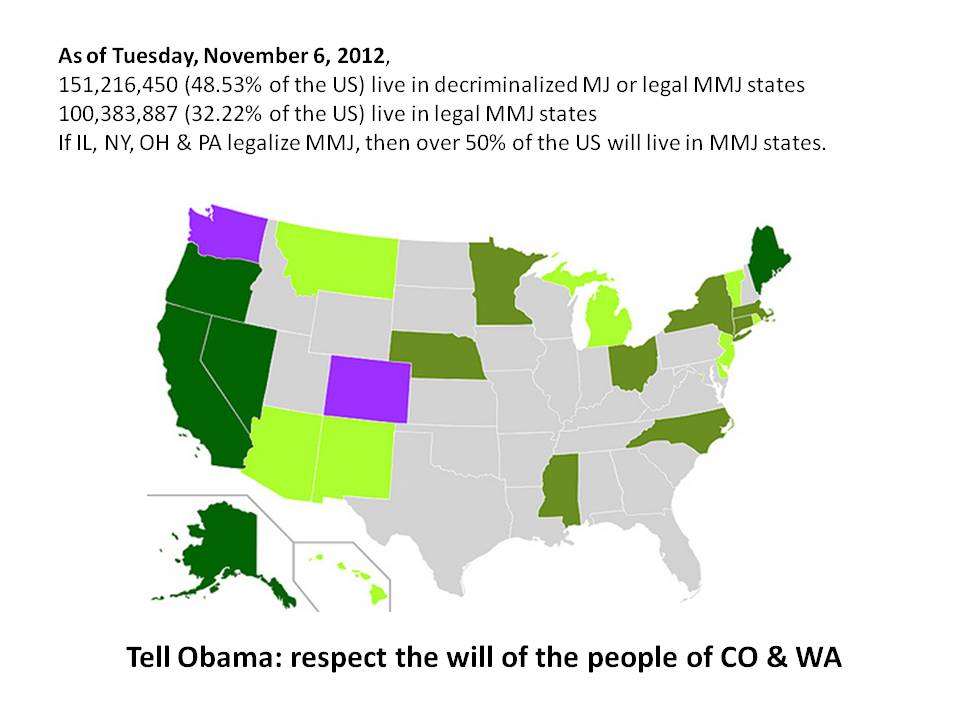
US states with Medical or decriminalized marijuana

States with medical or decriminalized marijuana

November 6 was a momentous day for drug policy reform; now we must make sure that the Federal Government doesn’t block the initiatives approved by a large majority of the voters of Colorado and Washington.

Ask President Obama to respect the will of the people of the states of Washington and Colorado. Sign and promote the petition http://www.world-war-d.com/2012/11/07/petition-washington-and-colorado/. Don’t wait for the Feds’ reaction, act now!

Jeffrey Dhywood
Investigative writer
Author of “World War D – The Case against prohibitionism, roadmap to controlled re-legalization” http://www.world-war-d.com/
“World War-D” on Amazon: www.amazon.com/dp/0984690409/
http://www.facebook.com/worldward
Twitter:@JDhywood
LinkedIn: linkedin.com/in/jdhywood

Journalists wishing to arrange interviews with Jeffrey Dhywood should contact promo@world-war-d.com

Petition: President Obama, respect the will and state rights of the people of Washington and Colorado!

Ask President Obama to respect the right of the states of Washington, Colorado and all the states that have legalized medical marijuana

[emailpetition id=”3″]

As the drug policy debate moves to the US congress after the historic approval of marijuana legalization in the States of Colorado and Washington, we must keep the pressure. Stand firm for the defense of the newly gained right of the people of Colorado and Washington, as well as those of all the medical marijuana states. Add your name to this petition and it will be delivered to the White House.

We also encourage you to contact the White House directly at http://www.whitehouse.gov/contact.

Tweet the following message: @BarackObama we urge you to respect the will + rights of the people of WA + CO! http://ow.ly/f9KKx pic.twitter.com/r0AwewgP

Last but not least, help us promote this petition. Share this message with your email connections, share the link to the petition http://www.world-war-d.com/petition-wa-co/ on social networks, blogs, groups, etc.

We need your support

Jeffrey Dhywood
Investigative writer
Author of “World War D – The Case against prohibitionism, roadmap to controlled re-legalization” http://www.world-war-d.com/
“World War-D” on Amazon: www.amazon.com/dp/0984690409/
http://www.facebook.com/worldward
Twitter:@JDhywood
LinkedIn: linkedin.com/in/jdhywood

Journalists wishing to arrange interviews with Jeffrey Dhywood should contact promo@world-war-d.com


Marijuana election-night coverage: Tuesday November 6th, 7-11pm EST

Tune-in to witness history as it unfolds!

http://kopproductions.com/show-page/ 

Tomorrow two states are poised to legalize marijuana, and the War on Drugs will be dealt a severe blow. I invite you to witness history in the making with KOP productions in Massachusetts, a state expected to deliver a landslide medical Marijuana victory.

KOP-productions has lined up an impressive roster of prestigious guests speakers to comment live on the polls results as they come out. Guests include:

  • Neil Franklin, Executive Director of LEAP (Law Enforcement against Prohibition), an Organization started in MA by former undercover DEA agent Jack A. Cole;
  • Maine Representative Diane Russell;
  • Paul Stanford, President of The Hemp & Cannabis Foundation
  • Yours truly, Jeffrey Dhywood. I will be giving away signed copies of my book “World War D – The Case against prohibitionism, roadmap to controlled re-legalization” during the show.
  • Also direct from California, the 420 Nurses and The 420 Comic;
  • In-studio Guest, BOBBY NUGZ from Releaf Magazine in Rhode Island.

    More guests announcements right up to the show.

The show will be simulcasted on 2 websites:

There will be plenty of giveaways: T-shirts, books, and special prizes from sponsors to lucky callers when KOP open their Studio lines during the evening. 1-401-626-4420.

Get ready for surprise announcements and calls to action during the show. Even if we get the expected two victories, the war on drugs will not end tomorrow; but tomorrow can mark a major tide-reversal if we are ready to intensify the fight against ignorance, misconceptions, preconceptions and deeply-entrenched taboos fueled by the 100-years prohibitionist propaganda machine. The war is far from over; only through our joint efforts will common sense and sanity prevail at long last.

Tune in at 7:00 pm EST (that’s East Coast time) and be part of history!

Invite your friends and contacts! Share on social networks! We expect a great show tomorrow!

Jeffrey Dhywood
Investigative writer,
Author of “World War D – The Case against prohibitionism, roadmap to controlled re-legalization”
Download a free 50 pages excerpt of  “World war-D”
Facebook page: http://www.facebook.com/worldward
Follow me on Twitter: @JDhywood
LinkedIn: http://hk.linkedin.com/in/jdhywood
Become a better informed activist and support global drug policy reform! Order your own copy of “Word War-D”.

  • The reference book on the War on Drugs and prohibitionism
  • A guide to psychoactive substances and substance abuse
  • A blueprint for global drug policy reform and controlled legalization

(Click here to order “World War-D” from Amazon)
If you agree with our views, please share this post to support our cause. Send it to at least 5 of your friends, post it on social networks, on your blogs, etc.

Marijuana Legalization initiatives are under pressure and need your help

10 days before election-day, the marijuana legalization initiatives are slipping in the polls; Washington I502 is still ahead, but support is softening; Colorado 64 is in dangerous zone; Oregon Measure 80 is trailing badly. We need a general mobilization of the drug policy reform activists. We need unity, not internal infighting.

I urge the marijuana activists who are OPPOSING the marijuana legalization initiatives in Washington or Colorado to reconsider their position.

Will these initiatives grant all the policies on the activists’ wish list? No, they won’t! But it will be a vast improvement over the existing regulations, which are medical marijuana in both states, just like medical marijuana is an awkward compromise, but that is vastly preferable to prohibition. With the Washington and Colorado initiatives, the medical marijuana will lose the tax-free easy profits it has been enjoying in the legal grey-zone where it has been operating for the past few years. On the other hand, it will reduce the fear of the Feds, the raids in the wee hours of the day, the drug squads knocking down your door in your sleep. It won’t eliminate the threats from the fed, but instead on fighting on your own, the state will fight for the industry, which makes a huge difference.

Yes, the initiatives on the ballot have restrictions that are questionable within the activists’ community. Could the initiatives be less restrictive? For an answer, let’s look at the polls: I502 in Washington is the most restrictive of the three initiatives on the ballot. It is the one with highest polling and the only one with a very good chance of passing. Amendment 64 in Colorado is not as restrictive but is in a thigh race and sagging support as we get closer to election-day. Measure 80 in Oregon, which is the closest to the marijuana activists’ wish-list is trailing badly in the polls and stands little chance of winning. It is quite clear that with all their flaws, the initiatives are already pushing the limits of what voters are willing to accept.

The lessons we can draw here are quite clear: the general public might be ready for some restrictive form of marijuana legalization under tight control, but is not ready for more lax policies. In particular, the public wants reassurances on protection of minors and driving under the influence. The public wants to make sure that we do not replace bad policies with even worse policies. Last but not least, drug prohibition has been going on for over 100 years, marijuana prohibition for 75 years. For all that time, the public has been bombarded by a constant and sustained barrage of propaganda, depicting drugs in general and marijuana in particular as evil and worse. It will take a long time to undo the effects of a century-long propaganda machine. We need incremental steps to reassure the public that the sky will not fall after marijuana legalization. The public has legitimate concerns about the children and youths and will not accept alternatives that do not restrict underage access. The current medical marijuana laws in California for instance, have provoked serious backlash as dispensaries were popping up all over the place, especially around schools, with hawkers peddling marijuana cards on street corners.

Finally, legislations are not written in stone; they change and evolve, as we are currently witnessing. Alcohol regulations were quite restrictive when prohibition was first lifted, and have become increasingly lenient as time goes by. The same will happen with marijuana regulations if we ever get to end prohibition.

Bottom line: Do you prefer to fight from a purist, principled position that doesn’t stand the slightest chance of ever winning enough support, or are you ready to settle on a reasonable compromise that can move the debate to the next step?

Jeffrey Dhywood
Investigative writer,
Author of “World War D – The Case against prohibitionism, roadmap to controlled re-legalization”

“World War-D” on Amazon: http://www.amazon.com/dp/0984690409/

www.world-war-d.com
Facebook page: http://www.facebook.com/worldward
Twitter: @JDhywood
jd (at) world-war-d.com

Petición de apoyo a la legalización controlada de marihuana en Uruguay

[emailpetition id=”2″]

Click here for English version

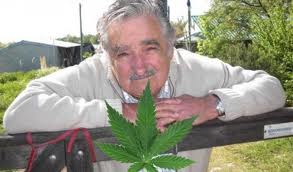
El gobierno uruguayo anunció el 20 de junio que enviaría una iniciativa de ley para la legalización de la venta de la mariguana (la posesión y uso ya son legales en este país). Si se aprueba esta ley, Uruguay sería el primer país en el mundo en establecer un mercado legal para la mariguana; esto sería un cambio paradigmático mayor ya que rompería el tabú, cuestionaría leyes internacionales existentes y sentaría un precedente único. En el últimos año, Uruguay también ha estado debatiendo la posibilidad del cultivo de la mariguana para uso personal. Si ambas medidas se aprueban esto sería un gran paso adelante.
Sabemos que vendrá mucha presión en contra del gobierno uruguayo para que abandone este proyecto de legalización, tal como se hizo contra Guatemala y sus vecinos en febrero de este año. No podemos correr el riesgo de que Uruguay abandone la iniciativa por la presión de quienes no desean hacer un cambio.
Al firmar la carta por debajo, se la enviará con su firma al Presidente José Mujica y los dos principales partidos de oposición.
Recuerde: En este momento, la iniciativa es sólo una propuesta que requiere la discusión y aprobación parlamentaria. Para aquellos quienes opinen que la iniciativa no va lo suficientemente lejos o que le da demasiado control al gobierno, piensen que el Presidente Mujica y su gobierno están enfrentando una batalla cuesta arriba con el muy seguro linchamiento por parte del gobierno norteamericano. No hay en este momento, ninguna seguridad de que la iniciativa sea aprobada por lo que debemos apoyarla.
Nosotros podemos hacer la diferencia.
Por favor comparte con tus conocidos y amistades este blog en Facebook, Twitter , otros medios sociales y por correo electrónico

También puedes twittear a:
• Presidencia de Uruguay: @SCpresidenciauy
• Senador Jorge Larrañaga, @guapolarranaga, líder de Alianza Nacional
• Pedro Bordaberry @PedroBordaberry, presidente del CEN Colorado y quien fuera ministro de Industria y Turismo en el gobierno de Jorge Batlle, primer jefe de estado en proponer la legalización de las drogas en 2000
Para leer más sobre la iniciativa de ley: http://www.presidencia.gub.uy/wps/wcm/connect/Presidencia/PortalPresidencia/Comunicacion/comunicacionNoticias/gabinete-seguridad-presento-paquete-15-medidas-promover-convivencia-ciudadana
La declaración a medios de la presidencia uruguaya: http://medios.presidencia.gub.uy/jm_portal/2012/noticias/NO_E582/Estrategia.pdf
Para leer más sobre el Presidente Mujica: http://en.wikipedia.org/wiki/Jos%C3%A9_Mujica

Conviértete en un activista mejor informado!
Apoya la reforma global de la política de drogas!
Pida su propia copia de “World War-D”, el libro de referencia sobre el prohibicionismo, sustancias psicoactivas y la reforma de la política de drogas (disponible solamente en Ingles por el momento)!

Jeffrey Dhywood

Autor de investigación y análisis de “World War D – The Case against prohibitionism, roadmap to controlled re-legalization”

Twitter: @JDhywood

Facebook: http://www.facebook.com/worldward


Petition in support of the controlled legalization of Marijuana in Uruguay

[emailpetition id=”1″]

Haga clic aquí para versión en español

On November 15, the government of Uruguay submitted to its parliament a proposal for the legalization of the sale of marijuana under state control (possession and use of marijuana is already legal in Uruguay). The project would also legalize the cultivation for personal use of up to 6 plants of cannabis. If adopted, Uruguay would become the first country in the world to establish a controlled marketplace for marijuana.

The project has already been approved by the Officialista Party, who holds a majority in the lower chamber, and is not submitted for comments to the opposition party. It is noteworthy that the major opposition parties have themselves asked for legalization of cultivation for personal use in the past.

President Mujica has scheduled a month-long national debate on his proposal.  We cannot afford to drop the ball on Uruguay.

When you sign the letter underneath, it will be sent with your signature to President José Mujica and the two major opposition parties. Please share this blog  post on Facebook, on Twitter and other social medias or by email.

Remember: This is just a proposal for the time being, and it needs to go thru parliamentary approval. For those you who think that it doesn’t go far enough, that it gives too much control to the government, just think about the uphill battle President José Mujica and his government are facing, and the expected US government’s stonewalling. There is absolutely no guarantee that this proposal will go thru, which is why we need to show our support.

For more impact, you can also tweet to the following:

Presidency of Uruguay: @SCpresidenciauy

Senator Jorge Larrañaga, @guapolarranaga, leader of Alianza Nacional

Pedro Bordaberry, @PedroBordaberry, President of the CEN colorado, was minister of Tourism and Industry in the Government of Jorge Batlle, the first head of state in the world to call for the legalization of all drugs in 2000, shortly after taking office.

Become a better informed activist and support global drug policy reform! Order your own copy of “Word War-D”, the reference book on prohibitionism, psychoactive substances and drug policy reform!

Learn more about the proposal: http://www.desdeelmarmol.com/2012/11/ley-sobre-regulacion-de-la-cadena.html

Learn more about President José Mujica: http://en.wikipedia.org/wiki/Jos %C3%A9_Mujica

Jeffrey Dhywood

Investigative writer,
author of “World War D – The Case against prohibitionism, roadmap to controlled re-legalization”

Download a free 42 pages excerpt of  “World war-D”

Twitter: @JDhywood
Facebook: http://www.facebook.com/worldward

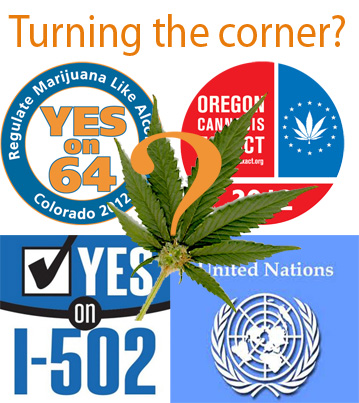
Are we turning a corner in the War on Drugs?

The likely victory of marijuana legalization in Washington and Colorado will transform the global drug policy debate

A landmark victory of marijuana legalization in Washington and Colorado will put internal & external pressure for drug policy reform on the US and weaken its hand with its restive Latin American allies.

A likely marijuana legalization victory will transform the global drug policy debate

After declaring in 1971 “We must wage total war against public enemy number one in the United State, the problem of dangerous drugs”, President Richard Nixon prematurely claimed victory On September 11, 1973, “We turned the corner on drug addiction in the United states. Drug addiction is under control.” Almost 40 years later, we might indeed be turning a corner in the war on drugs, though not quite the corner envisioned by Nixon, as 2012 is poised to enter the history books as a turning point in the failed war on drugs, and will hopefully signal the beginning of its unfolding.

Discontent about the failed war on drugs policies has been brewing for quite a while, especially in Latin America, but outside of that region, the debate rarely reached much beyond academic and activist circles. Things changed in June 2011 when drug policy reform grabbed the headlines across the world for the very first time with the publication of the Global Commission on Drug Policy Report. The report was signed by an impressive slate of prestigious individuals including seven former heads of state and the former UN Secretary General Kofi Annan, and was a seminal event for drug policy reform. Another seminal event, The Merida Declaration on December 6, 2011, went virtually unnoticed by the media and drug policy experts alike. Issued at the Tuxtla Dialogue and Agreement Mechanism in Yucatan, Mexico, the declaration was signed by eleven heads of state and high-level representatives of Central America and the Caribbean, including Mexico, Colombia and Chile, and asked “consuming countries … to explore possible alternatives …, including regulatory or market oriented options.”

2012 started with a bang when retired right-wing general Otto Perez Molina, newly elected president of impoverished Guatemala, rattled the world and instantly placed his country on the map by declaring the war on drugs a failure and forcefully advocating legalization. Guatemala is one of the world’s worst-hit countries by narco-violence, together with its unfortunate neighbors, Honduras and Salvador, and recently emerged from a decades-long brutal civil war.

Perez Molina has been unwavering ever since. He brought the drug legalization debate to the April Summit of the Americas, a gathering of all heads of state across the continent, from Canada to Tierra del Fuego, except Cuba (banned by the US). More recently, he brought the debate to the UN general Assembly and was joined by Mexico and Colombia, the two major US allies in the War on Drugs, for a call to revise the international treaties on illicit drugs.

As Perez Molina is actively trying to build a coalition for drug policy reform, he announced on Thursday a planned meeting with newly re-elected Hugo Chavez with legalization on the agenda. Venezuela is a major entry-point on the transit route of cocaine to the US through its extremely porous frontier with Colombia, and has often been a safe haven for Colombian narco-traffickers. However, the relationship between the Chavez regime and his cumbersome guests seems to be turning sour as violence has escalated dramatically in the country. Leftish Chavez joining right-wing Perez Molina in a coalition for drug policy reform might mollify the other members of the leftish Latin American coalition that includes Peru, Ecuador and Bolivia. Left-leaning Argentina president Kirchner might join as well. Uruguay announced in June its intention to legalize marijuana under state control and the proposal is currently churning through the legislative process.

The US being by far, the largest market for illegal drugs in the world, the marijuana legalization initiatives on the ballot in Colorado, Washington and Oregon take special significance in such a context. It is noteworthy that the US Justice Department has so far refrained from taking a position on these initiatives despite being urged by legalization opponents.

November 6 is likely to be a watershed moment for marijuana legalization and drug policy reform with the marijuana legalization initiatives standing very good chances in Colorado and Washington. Both initiatives enjoy wide support across the political spectrum ranging from the state democratic party to the GOP US Senate Candidate for Washington, Michael Baumgartner, or former GOP Congressman Tom Tancredo in Colorado. Sponsored by former US attorney John McKay and current City Attorney Peter Holmes, and with backing from the mayor and the entire city council of Seattle as well as the Seattle Times, the Washington initiative lines up the most impressive slate of main-stream backing and enjoys double digit margins in the polls. Curiously, in Washington and Colorado, the staunchest opposition is coming from the medical marijuana communities. The Oregon initiative, placing no restrictions on cultivation for personal use, is generally considered too radical and faces an uphill battle. A medical marijuana initiative, currently polling at a whopping 69%, could provide the icing on the cake with a landslide victory in Massachusetts.

A victory for marijuana legalization initiatives in the US would have momentous implications for Latin America and would place the federal government in an awkward position, caught between internal and external pressure for reform. It would certainly weaken its hands in its negotiations with its increasingly restive allies in the war on drugs. It might also give the needed impetus for the crystallization of a coalition of the willing and rally the support of the countries such as Costa Rica that have prudently stayed on the sideline until now.

The 22nd Ibero-American Summit, held on November 16 – 17 2012 in Cadiz, hosted by Spain and attended by Portugal and most Latin American countries will provide a good test of the effects of a marijuana legalization victory. Portugal and Spain having some of the most liberal drug policies in the world, this summit should offer a favorable environment for an open debate on drug policy reform. Scheduled 10 days after the November US election, it might embolden Colombia and Mexico to take more assertive positions. It may also present an opportunity for the budding coalition to grow some offshoots or support on the old continent.

Unknown is the potential reaction of the federal government to state legalization. While a lot depends on who will be the next host of the White House, the next president’s options might be limited, especially as a likely solid victory in Washington and a landslide medical marijuana victory in Massachusetts might diametrically reverse the political risk of marijuana legalization, with opposition to the issue becoming increasingly politically risky.

If the federal government chooses confrontation, it can expect a vigorous fight from the states. Already, the City of Oakland became on October 11, the first known jurisdiction to sue the federal government to protect its medical marijuana industry. Lawsuits are being brought in San Diego to reverse federal convictions in medical marijuana cases. There is no doubt that victory in November will embolden the states to resist federal interference with their marijuana policies. A corner will most likely be turned in the War on Drugs on November 6, 2012, a corner towards legalization.

Jeffrey Dhywood
Investigative writer,
Author of “World War D – The Case against prohibitionism, roadmap to controlled re-legalization”

www.world-war-d.com
Facebook page: http://www.facebook.com/worldward
Twitter: @JDhywood
jd (at) world-war-d.com


MJ legalization initiatives and emergence of a coalition for drug policy reform in Latin American

Colombia, Guatemala and Mexico issued a joint declaration demanding the UN revision of drug policyIn a significant development in the rapidly evolving drug policy debate, the governments of Colombia, Guatemala and Mexico issued on Monday October 1 a joint declaration demanding the UN revision of drug policy. In their declaration, the three countries denounce the failure of the current prohibitionist drug policies and request “That the United Nations [] exercise it´s leadership … to analyze all available options, including regulatory or market measures, in order to establish a new paradigm that prevents the flow of resources to organized crime organizations.” The three governments “invite Member States of the Organization of the United Nations to undertake very soon a consultation process” and call for “an international conference to allow the necessary decisions in order to achieve more effective strategies and tools with which the global community faces the challenge of drugs and their consequences.”

Read the entire declaration in Spanish, and its English translation

In another development, the Mexican businessman Ricardo Salinas, head of the Grupo Salinas and of TV Azteca, advocated drug legalization at the annual meeting of the Association of American Chambers of Commerce in Latin America in Washington DC. This is quite significant because Salinas is one of the major backers of President elect Pena Nieto, who will take office on December 1.

It seems that we are witnessing the emergence of a Latin American coalition for drug policy reform led by Guatemala, Colombia and Mexico. The active support of Colombia and Mexico would undoubtedly change the balance of power and turn the tables on the US.

In this context, a victory for one or more of the marijuana legalization initiatives in November could be game changer, especially as the number of medical marijuana states keeps growing, most of them solidly democrats or democrat-leaning. If reelected, Obama and the Democratic Party might finally realize that they have more to lose than to gain in pursuing their current hard-line policies. Meanwhile, an internal challenge to the prohibitionist drug policy would seriously weaken the US hands in the drug policy debate with its Latin American allies.

Success is definitively within reach in Colorado and Washington, but you support is urgently needed. First, if you live in Colorado, Oregon or Washington, you must of course go to the poll. But if you don’t there are many ways to support, starting with donations.

If you order “World War-D” on our website http://www.world-war-d.com/ before November 1st, 2012, we will donate $5.00 to the campaign of your choice. Just follow the instruction in your order confirmation email to select the campaign you wish to support.

You can also donate directly to the campaigns:
o   Colorado Amendment 64
o   Oregon Cannabis Tax Act (Measure 80)
o   Washington Initiative 502

2012 will be marked as a turning point in drug policy reform. Be part of history!
Thank you for your support

Jeffrey Dhywood
Investigative writer,
Author of “World War D – The Case against prohibitionism, roadmap to controlled re-legalization”
Download a free 50 pages excerpt of  “World war-D”
Facebook page: http://www.facebook.com/worldward
Follow me on Twitter: @JDhywood

LinkedIn: http://hk.linkedin.com/in/jdhywood

read more: http://www.world-war-d.com/2012/10/03/joint-declaration-of-colombia-guatemala-and-mexico-concerning-un-revision-on-drug-policy/

http://www.world-war-d.com/2012/10/03/declaracion-conjunta-de-los-gobiernos-de-colombia-guatemala-y-mexico/

http://www.vanguardia.com.mx/salinaspliegopideacamaradecomerciodeeulegalizardrogas-1386975.html

Drug legalization debate brought to the UN General Assembly

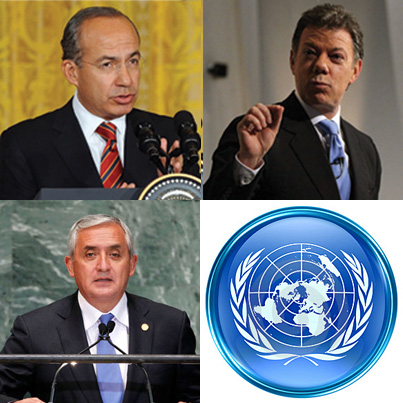
The 76th UN assembly opened its doors in New York yesterday, Monday September 24, and for the first time ever, drug legalization will be brought up by no less than three Latin American heads of state.

Both Guatemalan and Colombian presidents have scheduled talks on Wednesday and both have already announced their intention to bring up the issue of global drug policy reform.  Guatemalan president Perez Molina has been the most forthcoming, and announced his intention to ask for a global dialog about new approaches to the fight against drug trafficking, including drug legalization. He will also request a revision to the Single Convention on Narcotic Drugs of 1961 as amended by the 1972 Protocol.  Perez Molina reiterated that the 50 years old war on drugs has failed and that it is time to look for more viable alternatives.

Colombian president Santos has been more ambiguous, and while he has been building up expectations for his upcoming talk at the UN, he also reminded that drug trafficking is punished by death penalty in many parts of the world. Let’s hope this is not what he means when he talk about “grabbing the bull by the horns”.  More likely, Santos is contrasting the two extreme approaches of free-market and death sentencing to the current failed policies. While he has been hinting for a while his support for controlled regulation, so far, he has failed to take a resolute stand.

The case of Calderon is more puzzling. Yesterday, September 24, the Mexican president, whose term ends on December 1st, conceded: “ Let’s be honest, I don’t see any [solution] other than the regulation of drugs in the global marketplace, starting here, in the United States.” (“Seamos honestos: no se me ocurre otra que no sea la regulación de las drogas en el mercado global, empezando por aquí, por Estados Unidos”).  He then lamented the 60,000 deaths caused by his own militarization of the fight against narco-trafficking. Where was he for the past 6 years? Will Calderon join the exclusive but growing club of retired heads of states asking for drug policy reform? As it seems that his market approach epiphany dates back to 2011 at least, one wonders why he didn’t act on it while he was in position to do so. As for his successor Enrique Peña Nieto, he has been wavering back and forth and his position seems hard to pinpoint, but as recently as Monday September 4th, he has been encouraged by Calderon himself to explore other alternatives, the codeword for legalization.

It is significant that the debate is brought up by three conservative, well-respected heads of state with impeccable credentials, representing countries that have paid a very high price in the war on drugs. While it is doubtful that the UN discourses about drug policy reform could result in any concrete action in the near future, it still marks a significant shift, especially as the UN Assembly is an opportunity for multilateral exploratory contacts that may coalesce down the line into a coalition of the willing to legalize.  Santos will meet in New York with UK Prime Minister David Cameron, who advocated drug policy reform before assuming office, but backed off since then. The path to global drug policy reform must pass through the UN sooner or later. This could be the exploratory stage of the process.

Santos has repeatedly affirmed his support for controlled legalization, always adding the caveats that legalization can only work globally, that it cannot be implemented unilaterally, and that he doesn’t want to take the lead of a coalition for legalization. Still, someone will need to bite the bullet and take the lead sooner or later. Perez Molina has tried to assume this role since taking office last January, but Guatemala is a clout-less, small impoverished country emerging from a brutal civil war; it was considered a pariah state plagued by human right abuses and systemic corruption until very recently. Molina was met with staunch opposition by his immediate neighbors Nicaragua, Honduras and El Salvador. Only Costa Rica responded favorably to Perez Molina’s initiative, who also got the ambiguous support of Colombia. Drug legalization was discussed at the April 15-16 OAS (Organization of American States) Summit in Cartagena, Colombia, but such discussion didn’t go much further than the acknowledgment that legalization is a valid point of discussion. As usual, a commission has been created to study drug policy alternatives, with a report scheduled for publication in June 2013; considering that the report will need the US and Canadian seal of approval, expectations shouldn’t be set too high.

Bottom-line: as Perez Molina is acutely aware, a Latin American coalition for drug policy reform won’t go anywhere without Colombia and Mexico onboard, and Latin America is the only part of the world where global drug policy reform can be initiated. Nevertheless, even if a lot remains to be done, we must acknowledge the astounding progress made since January of this year. A taboo has undoubtedly been broken; drug policy reform has become an almost mandatory topic at international meetings involving Latin America countries. Tiny Uruguay is debating the legalization of marijuana under state control; after having been dubbed the Switzerland of Latin America, Uruguay could very well become the Portugal of Latin America. The prospect of marijuana legalization in Uruguay has been met with surprisingly tepid opposition from the UN and the US, who might secretly welcome a sort of social and regulatory laboratory in this prosperous, non-strategic country with a long tradition of independence and great human rights records.

The November elections in the US could also be a game-changer if marijuana legalization initiatives are approved in Colorado and Washington State as polls seem to indicate. Such a move would most likely embolden Latin America.

Finally, we should keep our eyes open for the 22nd Ibero-America Summit, November 16 – 17 2012 in Cadiz, hosted by Spain and attended by Portugal and most Latin American countries. Portugal and Spain having some of the most liberal drug policies in the world, this summit should offer a favorable environment for an open debate on drug policy reform. Scheduled after the November US election, it might embolden Colombia and Mexico to take more assertive positions, especially if marijuana legalization initiatives succeed in Washington and/or Colorado.

Jeffrey Dhywood
Investigative writer,
Author of “World War D – The Case against prohibitionism, roadmap to controlled re-legalization”

Download a free 50 pages excerpt of  “World war-D”

Facebook page: http://www.facebook.com/worldward

Follow me on Twitter: @JDhywood

Become a better informed activist and support global drug policy reform! Order your own copy of “Word War-D”

  • The reference book on the War on Drugs and prohibitionism
  • A guide to psychoactive substances and substance abuse
  • A blueprint for global drug policy reform and controlled legalization

(Click here to order “World War-D” from Amazon)

If you agree with our views, please share this post to support our cause. Send it to at least 5 of your friends, post it on social networks, on your blogs, etc.

Further reading:

http://www.publinews.gt/index.php/felipe-calderon-habla-de-regular-drogas-en-onu/

http://m.eltiempo.com/politica/los-puntos-claves-del-discurso-de-juan-manuel-santos-en-la-asamblea-general-de-la-onu/7979960/1

http://www.elperiodico.com.gt/es/20120925/pais/218373/

http://www.guatemala.gob.gt/index.php/2011-08-04-18-06-26/item/1581-migrantes-y-pol%C3%ADtica-de-lucha-contra-las-drogas-entre-temas-del-presidente-p%C3%A9rez-molina-ante-asamblea-general-de-la-onu
Drug legalization debate intensifies in Latin America

The state of drug policy Reform in Latin America

Latin America has been (and still is) the hardest-hit region by the War on Drugs. It shouldn’t come as a surprise that it is the part of the world with the most vigorous debate about drug policy reform as governments look for alternatives to the failed policies of the War on Drugs. The debate is hampered by the long-entrenched prohibitionist credo and extreme pressure from the big Northern neighbor. According to Mexican president Felipe Calderon though, there was only one consensus at the April 15th Summit of the Americas: that the drug policy debate needs to be open to all alternatives.

Long confined to somewhat rarefied academic circles and the ultra-select ex-presidents club, the debate has now moved into the mainstream and is regularly capturing headlines; the taboo has been broken. Presidents don’t wait anymore for retirement before speaking out and discussion is finally leading to action. Even church leaders and Archbishops are joining the drug-reformist camp.

Last January, Guatemalan president Otto Perez Molina famously threw a stone in the war on drug murky pound and has stuck to his guns ever since. He boldly threw the debate into the April OAS meeting and is now ready to present his controlled regulation proposal to the 76th UN assembly in New York on September 26. He plans to use the platform to further advance the idea with other heads of state.

Meanwhile, the OAS (Organization of American States) will invest $2.4 million to investigate alternatives to the current fight against drug-trafficking and study the feasibility and the potential social and economic impact of legalization. A commission of experts will present its finding at the OAS General Assembly, in Antigua, close to Guatemala City, where the Perez Molina’s proposal will be discussed in details. It is of course anybody’s guess of what will be left of the committee’s recommendations after its report has been revised by the US and Canadian censors.

Tiny Uruguay, often dubbed the Switzerland of Latin America, threw itself on the map last June when President Jose Mujica and his government announced their intention to legalize marijuana under state control. The marijuana legalization project is now in the parliamentary pipeline and is being debated as we speak. What is remarkable here is that both the governing party (Frente Amplio) and its opposition (Partido Nacional) both agree on the failure of prohibitionism around the world. Of course, for people living in the US, it is unthinkable that democrats and republicans may agree on anything beyond blind allegiance to the failed War-on-Drugs policies. But if they agree on the diagnostic, the two parties diverge on the cure.  It should be noted that marijuana regulation has been on the Uruguayan parliamentary agenda in one form or another for almost two years, with various schemes being debated, including legalizing the cultivation for personal use and the current proposal for state regulation.

With a population of barely 3.5 million, Uruguay has the highest per capita income, highest literacy rate and lowest crime rate in Latin America, but it had the recent misfortune to be located on one of the new transit routes to Europe via West Africa and has been somewhat plagued by an invasion of pasta (cocaine-base). No need to say, Mujica’s proposal is generating a vigorous debate within the country and raising eyebrows and getting close attention in the surrounding countries, especially Argentina, Brazil and Colombia.

Argentina and Brazil are debating decriminalization of all drugs for personal use. The Supreme Court of Argentina already ruled unconstitutional the criminalization of drug use in 2009. In Colombia, the capital city of Bogota is debating an ambitious harm reduction program based on substitution and maintenance.  Most Latin American countries have decriminalized drug use and possession for personal use, or are in the process of doing it.

It seems that no regional meeting or summit can take place nowadays in this part of the world without drug policy debate on the agenda. The 22nd Ibero-America Summit, November 16 – 17 2012 in Cadiz, Spain, bringing together the heads of state from Latin America, Spain and Portugal, is no exception. Drug policy and the fight narco-trafficking will be front and center at the meeting of interior ministers.

Drug policy reform is clearly on the move, and as I predicted in my book “world War-D”, Latin America is taking the lead. The battle is far from over though and there is a long and arduous road ahead of us. Although they have been toying with it for a while, the heavyweights, Colombia and Mexico, are still on the sideline. Mexico for one, is caught in a time warp since the July 1st presidential elections and up to the December official transfer of power. Caught in his own controversies, President-elect Enrique Peña Nieto has mostly kept silent, trying to stay out of the limelight and sticking to non-controversial issues.

As always, your support can make a difference. As a reminder, we have 2 ongoing actions:

Petitions of support of Guatemalan president Otto Perez Molina http://signon.org/sign/support-guatemalan-president.

Petition in support of marijuana legalization in Uruguay: http://www.world-war-d.com/2012/06/22/petition-in-support-of-the-controlled-legalization-of-marijuana-in-uruguay/

If you haven’t done so yet, please sign these petitions. Help spread them through social networks and emails.

Thank you for your support.

Jeffrey Dhywood
Investigative writer,
Author of “World War D – The Case against prohibitionism, roadmap to controlled re-legalization”

Download a free 50 pages excerpt of  “World war-D”

Facebook page: http://www.facebook.com/worldward

Follow me on Twitter: @JDhywood

Become a better informed activist and support global drug policy reform! Order your own copy of “Word War-D”

  • The reference book on the War on Drugs and prohibitionism
  • A guide to psychoactive substances and substance abuse
  • A blueprint for global drug policy reform and controlled legalization

(Click here to order “World War-D” from Amazon)

If you agree with our views, please share this post to support our cause. Send it to at least 5 of your friends, post it on social networks, on your blogs, etc.

Further readings:

http://www.eltiempo.com/politica/lucha-contra-drogas-se-tomara-cumbre-iberoamericana-de-jefes-de-estado_12232229-4

http://www.latercera.com/noticia/mundo/2012/09/678-483568-9-oficialismo-y-oposicion-uruguaya-reconocen-fracaso-de-prohibicion-de-marihuana.shtml

http://www.telesurtv.net/articulos/2012/09/19/presidente-de-guatemala-propondra-en-onu-despenalizacion-de-la-droga-7325.html

http://www.laopinion.com/OEA_invertira_2.4_millones_dolares_para_despenalizacion_de_drogas .

http://www.drogasmexico.org/?nota=7288