Joint declaration of Colombia, Guatemala and Mexico concerning UN revision on drug policy

Colombia, Guatemala and Mexico issued a joint declaration demanding the UN revision of drug policy
Analyze all available options, including regulatory or market measures, in order to establish a new paradigm

The governments of Colombia, Guatemala and Mexico, are convinced that transnational organized crime and in particular the violence it generates when carrying out their criminal activities, present a serious problem that compromises the development, security and democratic coexistence of all nations, and that the United Nations must urgently address this issue:
We declare:
1. That use of illicit drug is a powerful incentive for the activities of criminal organizations in all regions of the world.

2. That despite the efforts of the international community over decades, the use of these substances continues to increase globally, generating substantial income for criminal organizations worldwide.

3. That having financial resources of enormous magnitude, organizations of transnational organized crime are able to penetrate and corrupt institutions of the States.

4. That it is essential to implement effective measures to prevent illegal flows of arms to criminal organizations.

5. As long as the flow of resources from drug and weapons to criminal organizations are not stopped, they will continue to threaten our societies and governments.

6. That, consequently, it is urgent to review the approach so far maintained by the international community on drugs, in order to stop the flow of money from the illicit drug market.

7. That this review should be conducted with rigor and responsibility, on a scientific basis, in order to establish effective public policies in this area.

8. That nations should intensify their efforts to further strengthen the institutions and policies of each country in the prevention and punishment of crime, their social programs in education, health, leisure and employment, as well as prevention and treatment of addictions to preserve social fabric.

9. That states should endorse their commitment to fight with determination and according to the principle of shared and differentiated responsibility, transnational criminal groups through mechanisms of international cooperation.

10. That the United Nations should exercise it´s leadership, as is it´s mandate, in this effort and conduct deep reflection to analyze all available options, including regulatory or market measures, in order to establish a new paradigm that prevents the flow of resources to organized crime organizations.

11. In this regard, the governments of Colombia, Guatemala and Mexico invite Member States of the Organization of the United Nations to undertake very soon a consultation process that allows, taking stock of the strengths and limitations of the current policy, and about the violence generated by the production, trafficking and consumption of drugs in the world.

We believe that these results should culminate in an international conference to allow the necessary decisions in order to achieve more effective strategies and tools with which the global community faces the challenge of drugs and their consequences.

Issued on Oct. 1, 2012.

Free Translation: The Guatemala Times –

http://www.guatemala-times.com/news/guatemala/3332-joint-declaration-of-colombia-guatemala-and-mexico-demanding-un-revision-on-drug-policy.html

Drug legalization debate brought to the UN General Assembly

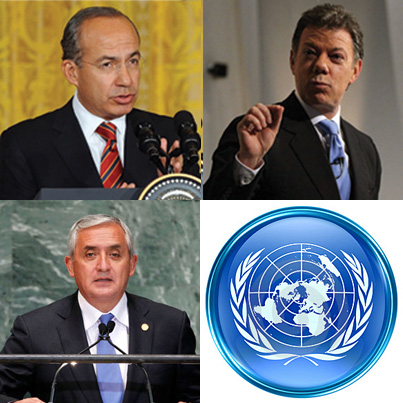
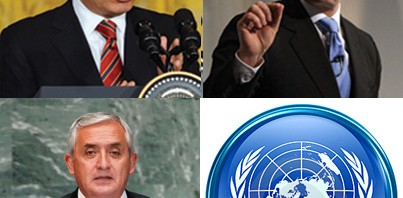
The 76th UN assembly opened its doors in New York yesterday, Monday September 24, and for the first time ever, drug legalization will be brought up by no less than three Latin American heads of state.

Both Guatemalan and Colombian presidents have scheduled talks on Wednesday and both have already announced their intention to bring up the issue of global drug policy reform.  Guatemalan president Perez Molina has been the most forthcoming, and announced his intention to ask for a global dialog about new approaches to the fight against drug trafficking, including drug legalization. He will also request a revision to the Single Convention on Narcotic Drugs of 1961 as amended by the 1972 Protocol.  Perez Molina reiterated that the 50 years old war on drugs has failed and that it is time to look for more viable alternatives.

Colombian president Santos has been more ambiguous, and while he has been building up expectations for his upcoming talk at the UN, he also reminded that drug trafficking is punished by death penalty in many parts of the world. Let’s hope this is not what he means when he talk about “grabbing the bull by the horns”.  More likely, Santos is contrasting the two extreme approaches of free-market and death sentencing to the current failed policies. While he has been hinting for a while his support for controlled regulation, so far, he has failed to take a resolute stand.

The case of Calderon is more puzzling. Yesterday, September 24, the Mexican president, whose term ends on December 1st, conceded: “ Let’s be honest, I don’t see any [solution] other than the regulation of drugs in the global marketplace, starting here, in the United States.” (“Seamos honestos: no se me ocurre otra que no sea la regulación de las drogas en el mercado global, empezando por aquí, por Estados Unidos”).  He then lamented the 60,000 deaths caused by his own militarization of the fight against narco-trafficking. Where was he for the past 6 years? Will Calderon join the exclusive but growing club of retired heads of states asking for drug policy reform? As it seems that his market approach epiphany dates back to 2011 at least, one wonders why he didn’t act on it while he was in position to do so. As for his successor Enrique Peña Nieto, he has been wavering back and forth and his position seems hard to pinpoint, but as recently as Monday September 4th, he has been encouraged by Calderon himself to explore other alternatives, the codeword for legalization.

It is significant that the debate is brought up by three conservative, well-respected heads of state with impeccable credentials, representing countries that have paid a very high price in the war on drugs. While it is doubtful that the UN discourses about drug policy reform could result in any concrete action in the near future, it still marks a significant shift, especially as the UN Assembly is an opportunity for multilateral exploratory contacts that may coalesce down the line into a coalition of the willing to legalize.  Santos will meet in New York with UK Prime Minister David Cameron, who advocated drug policy reform before assuming office, but backed off since then. The path to global drug policy reform must pass through the UN sooner or later. This could be the exploratory stage of the process.

Santos has repeatedly affirmed his support for controlled legalization, always adding the caveats that legalization can only work globally, that it cannot be implemented unilaterally, and that he doesn’t want to take the lead of a coalition for legalization. Still, someone will need to bite the bullet and take the lead sooner or later. Perez Molina has tried to assume this role since taking office last January, but Guatemala is a clout-less, small impoverished country emerging from a brutal civil war; it was considered a pariah state plagued by human right abuses and systemic corruption until very recently. Molina was met with staunch opposition by his immediate neighbors Nicaragua, Honduras and El Salvador. Only Costa Rica responded favorably to Perez Molina’s initiative, who also got the ambiguous support of Colombia. Drug legalization was discussed at the April 15-16 OAS (Organization of American States) Summit in Cartagena, Colombia, but such discussion didn’t go much further than the acknowledgment that legalization is a valid point of discussion. As usual, a commission has been created to study drug policy alternatives, with a report scheduled for publication in June 2013; considering that the report will need the US and Canadian seal of approval, expectations shouldn’t be set too high.

Bottom-line: as Perez Molina is acutely aware, a Latin American coalition for drug policy reform won’t go anywhere without Colombia and Mexico onboard, and Latin America is the only part of the world where global drug policy reform can be initiated. Nevertheless, even if a lot remains to be done, we must acknowledge the astounding progress made since January of this year. A taboo has undoubtedly been broken; drug policy reform has become an almost mandatory topic at international meetings involving Latin America countries. Tiny Uruguay is debating the legalization of marijuana under state control; after having been dubbed the Switzerland of Latin America, Uruguay could very well become the Portugal of Latin America. The prospect of marijuana legalization in Uruguay has been met with surprisingly tepid opposition from the UN and the US, who might secretly welcome a sort of social and regulatory laboratory in this prosperous, non-strategic country with a long tradition of independence and great human rights records.

The November elections in the US could also be a game-changer if marijuana legalization initiatives are approved in Colorado and Washington State as polls seem to indicate. Such a move would most likely embolden Latin America.

Finally, we should keep our eyes open for the 22nd Ibero-America Summit, November 16 – 17 2012 in Cadiz, hosted by Spain and attended by Portugal and most Latin American countries. Portugal and Spain having some of the most liberal drug policies in the world, this summit should offer a favorable environment for an open debate on drug policy reform. Scheduled after the November US election, it might embolden Colombia and Mexico to take more assertive positions, especially if marijuana legalization initiatives succeed in Washington and/or Colorado.

Jeffrey Dhywood
Investigative writer,
Author of “World War D – The Case against prohibitionism, roadmap to controlled re-legalization”

Download a free 50 pages excerpt of  “World war-D”

Facebook page: http://www.facebook.com/worldward

Follow me on Twitter: @JDhywood

Become a better informed activist and support global drug policy reform! Order your own copy of “Word War-D”

  • The reference book on the War on Drugs and prohibitionism
  • A guide to psychoactive substances and substance abuse
  • A blueprint for global drug policy reform and controlled legalization

(Click here to order “World War-D” from Amazon)

If you agree with our views, please share this post to support our cause. Send it to at least 5 of your friends, post it on social networks, on your blogs, etc.

Further reading:

http://www.publinews.gt/index.php/felipe-calderon-habla-de-regular-drogas-en-onu/

http://m.eltiempo.com/politica/los-puntos-claves-del-discurso-de-juan-manuel-santos-en-la-asamblea-general-de-la-onu/7979960/1

http://www.elperiodico.com.gt/es/20120925/pais/218373/

http://www.guatemala.gob.gt/index.php/2011-08-04-18-06-26/item/1581-migrantes-y-pol%C3%ADtica-de-lucha-contra-las-drogas-entre-temas-del-presidente-p%C3%A9rez-molina-ante-asamblea-general-de-la-onu

Drug legalization debate intensifies in Latin America

The state of drug policy Reform in Latin America

Latin America has been (and still is) the hardest-hit region by the War on Drugs. It shouldn’t come as a surprise that it is the part of the world with the most vigorous debate about drug policy reform as governments look for alternatives to the failed policies of the War on Drugs. The debate is hampered by the long-entrenched prohibitionist credo and extreme pressure from the big Northern neighbor. According to Mexican president Felipe Calderon though, there was only one consensus at the April 15th Summit of the Americas: that the drug policy debate needs to be open to all alternatives.

Long confined to somewhat rarefied academic circles and the ultra-select ex-presidents club, the debate has now moved into the mainstream and is regularly capturing headlines; the taboo has been broken. Presidents don’t wait anymore for retirement before speaking out and discussion is finally leading to action. Even church leaders and Archbishops are joining the drug-reformist camp.

Last January, Guatemalan president Otto Perez Molina famously threw a stone in the war on drug murky pound and has stuck to his guns ever since. He boldly threw the debate into the April OAS meeting and is now ready to present his controlled regulation proposal to the 76th UN assembly in New York on September 26. He plans to use the platform to further advance the idea with other heads of state.

Meanwhile, the OAS (Organization of American States) will invest $2.4 million to investigate alternatives to the current fight against drug-trafficking and study the feasibility and the potential social and economic impact of legalization. A commission of experts will present its finding at the OAS General Assembly, in Antigua, close to Guatemala City, where the Perez Molina’s proposal will be discussed in details. It is of course anybody’s guess of what will be left of the committee’s recommendations after its report has been revised by the US and Canadian censors.

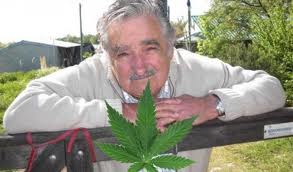
Tiny Uruguay, often dubbed the Switzerland of Latin America, threw itself on the map last June when President Jose Mujica and his government announced their intention to legalize marijuana under state control. The marijuana legalization project is now in the parliamentary pipeline and is being debated as we speak. What is remarkable here is that both the governing party (Frente Amplio) and its opposition (Partido Nacional) both agree on the failure of prohibitionism around the world. Of course, for people living in the US, it is unthinkable that democrats and republicans may agree on anything beyond blind allegiance to the failed War-on-Drugs policies. But if they agree on the diagnostic, the two parties diverge on the cure.  It should be noted that marijuana regulation has been on the Uruguayan parliamentary agenda in one form or another for almost two years, with various schemes being debated, including legalizing the cultivation for personal use and the current proposal for state regulation.

With a population of barely 3.5 million, Uruguay has the highest per capita income, highest literacy rate and lowest crime rate in Latin America, but it had the recent misfortune to be located on one of the new transit routes to Europe via West Africa and has been somewhat plagued by an invasion of pasta (cocaine-base). No need to say, Mujica’s proposal is generating a vigorous debate within the country and raising eyebrows and getting close attention in the surrounding countries, especially Argentina, Brazil and Colombia.

Argentina and Brazil are debating decriminalization of all drugs for personal use. The Supreme Court of Argentina already ruled unconstitutional the criminalization of drug use in 2009. In Colombia, the capital city of Bogota is debating an ambitious harm reduction program based on substitution and maintenance.  Most Latin American countries have decriminalized drug use and possession for personal use, or are in the process of doing it.

It seems that no regional meeting or summit can take place nowadays in this part of the world without drug policy debate on the agenda. The 22nd Ibero-America Summit, November 16 – 17 2012 in Cadiz, Spain, bringing together the heads of state from Latin America, Spain and Portugal, is no exception. Drug policy and the fight narco-trafficking will be front and center at the meeting of interior ministers.

Drug policy reform is clearly on the move, and as I predicted in my book “world War-D”, Latin America is taking the lead. The battle is far from over though and there is a long and arduous road ahead of us. Although they have been toying with it for a while, the heavyweights, Colombia and Mexico, are still on the sideline. Mexico for one, is caught in a time warp since the July 1st presidential elections and up to the December official transfer of power. Caught in his own controversies, President-elect Enrique Peña Nieto has mostly kept silent, trying to stay out of the limelight and sticking to non-controversial issues.

As always, your support can make a difference. As a reminder, we have 2 ongoing actions:

Petitions of support of Guatemalan president Otto Perez Molina http://signon.org/sign/support-guatemalan-president.

Petition in support of marijuana legalization in Uruguay: http://www.world-war-d.com/2012/06/22/petition-in-support-of-the-controlled-legalization-of-marijuana-in-uruguay/

If you haven’t done so yet, please sign these petitions. Help spread them through social networks and emails.

Thank you for your support.

Jeffrey Dhywood
Investigative writer,
Author of “World War D – The Case against prohibitionism, roadmap to controlled re-legalization”

Download a free 50 pages excerpt of  “World war-D”

Facebook page: http://www.facebook.com/worldward

Follow me on Twitter: @JDhywood

Become a better informed activist and support global drug policy reform! Order your own copy of “Word War-D”

  • The reference book on the War on Drugs and prohibitionism
  • A guide to psychoactive substances and substance abuse
  • A blueprint for global drug policy reform and controlled legalization

(Click here to order “World War-D” from Amazon)

If you agree with our views, please share this post to support our cause. Send it to at least 5 of your friends, post it on social networks, on your blogs, etc.

Further readings:

http://www.eltiempo.com/politica/lucha-contra-drogas-se-tomara-cumbre-iberoamericana-de-jefes-de-estado_12232229-4

http://www.latercera.com/noticia/mundo/2012/09/678-483568-9-oficialismo-y-oposicion-uruguaya-reconocen-fracaso-de-prohibicion-de-marihuana.shtml

http://www.telesurtv.net/articulos/2012/09/19/presidente-de-guatemala-propondra-en-onu-despenalizacion-de-la-droga-7325.html

http://www.laopinion.com/OEA_invertira_2.4_millones_dolares_para_despenalizacion_de_drogas .

http://www.drogasmexico.org/?nota=7288

Colorado, Oregon, Washington or … Uruguay, who will be first?

Will 2012 be the year?

Drug policy reform is moving along in the world and 2012 might very well be the year when marijuana will become legal in some part of the world, more precisely, somewhere in the Americas.

1st legal MJ: Colorado, Oregon, Washington or … Uruguay?
Colorado, Oregon, Washington or … Uruguay?

Uruguayan President Jose Mujica is plugging along with his marijuana legalization initiative, crisscrossing his country and the airwaves with his message, calling for a broad dialog on the issue. “We must stop looking the other way: The major problem is not marijuana, it is drug trafficking.” The project is being debated in the parliament, but no date has been set for a vote.  http://cnnespanol.cnn.com/2012/08/26/jose-mujica-el-problema-grave-es-el-narcotrafico-no-la-marihuana/. President Mujica received the support of various regional ex-presidents, with Cesar Gaviria of Colombia being his most vocal supporter, but was derided by ex-president Jorge Battle(of Uruguay), who on February 11, 2001, became the first head of state to call for drug legalization while still in office. Go figure. Any similarity with the Romneycare/Obamacare controversy is purely accidental of course. http://www.elobservador.com.uy/noticia/230808/batlle-proyecto-de-legalizacion-de-la-marihuana-es-para-el-libro-guiness-/

Ex-presidents Rodrigo Borja of Ecuador, and Ricardo Lagos of Chile have joined the club of anti-prohibitionist ex-heads of states. Ricardo Lagos Weber, son of the ex-president, even presented a proposal for the legalization of auto-cultivation and use of marijuana for medical purpose to the Chilean parliament, a proposal that was squarely rejected by president Sebastián Piñera  http://america.infobae.com/notas/56195-Pinera-La-droga-es-muerte-dolor-sufrimiento

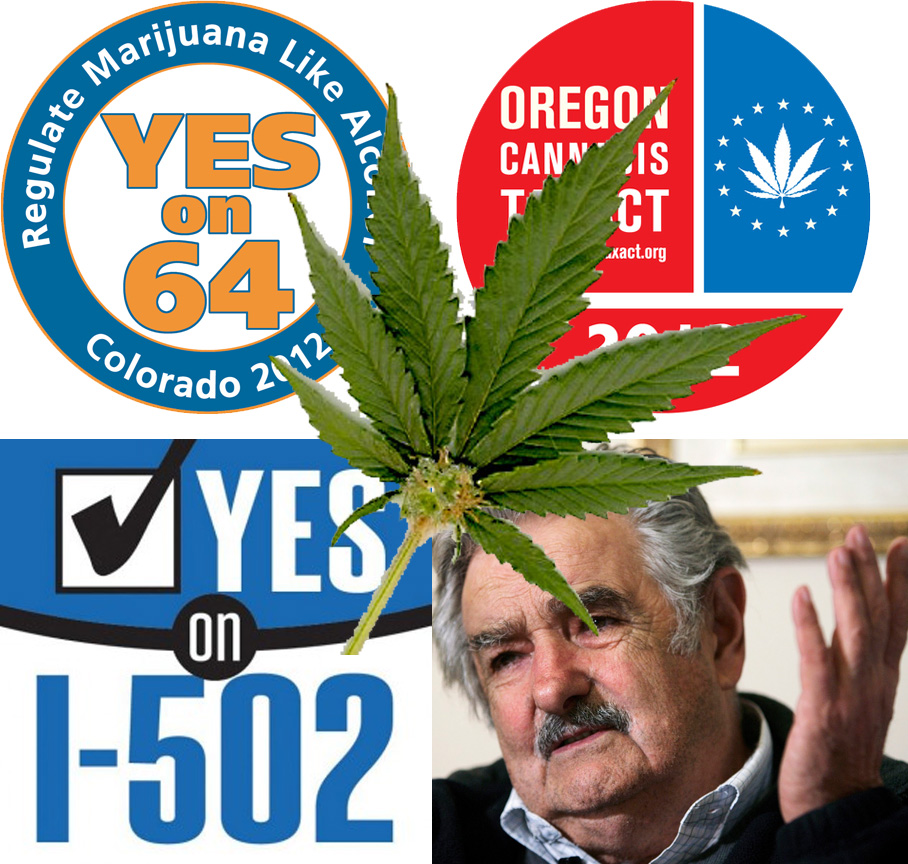
In the US, all three marijuana legalization initiatives on state ballots are gathering support left and right (mostly left though), including state legislators, the local democratic party and the NAACP.

Polls give a widening edge to the Colorado initiative with support growing to 47-38, and strong backing by independents. http://www.publicpolicypolling.com/main/2012/08/co-voters-favor-assault-weapons-ban-legal-pot-civil-unions.html#mor Washington fares even better with 50-37 support. The more controversial Oregon initiative is not doing too good, with negative support at 43-46. http://www.wweek.com/portland/article-19599-mari_wanna.html . While Washington and Colorado are sitting on comfortable piles of cash, Oregon is broke and could use some help. You can pitch in at Oregon campaign donations www.octa2012.com.

Put your money where your mouth is, support the marijuana legalization initiatives in all three states, Colorado http://www.regulatemarijuana.org/, Oregon www.octa2012.com and Washington http://www.newapproachwa.org. You can also spread the theme song for Colorado prop 64 http://www.regulatemarijuana.org/news/listen-yes-64-theme-song.

Each of these initiatives has its strengths and weaknesses, and none of them is perfect, but they certainly are a big step in the right direction and deserve your support.