Drug Policy Reform World Brief

Drug policy reform in the making

Europe

Residents of Switzerland and the Basque Region of Spain can legally grow MJ for personal use since January 1st, 2012.

Denmark: The City Council of Copenhagen voted for legalizing marijuana. In the proposed scheme, cannabis products would be available in restricted quantities in government-run specialized stores. The government would also regulate production.

http://www.telegraph.co.uk/news/worldnews/europe/denmark/8899243/Copenhagen-votes-to-legalise-marijuana.html

http://eudrugpolicy.org/node/108

Poland: On December 9 the new Polish drug law came into effect and liberalized the drug policy. According to the new rules, the prosecutor will be able to dismiss the criminal charges if the offender possessed only small amount of drugs for personal use and he finds that punishment is not necessary.

Poles were asked about the idea of legalizing marijuana possession for personal use. On December 12th 2011, 67% of respondents answered yes, while only 32% said no – and about 1% of respondents were undecided. These results show that the public attitudes to drug policy liberalization are changing rapidly in Poland.

In the US:

Four states have asked federal officials to reclassify marijuana (Washington, Colorado, Vermont and Rhode Island.

MJ legalization initiative will be on the ballot in 2012 in Colorado, Washington, and probably California.

UK: The widely respected “The Lancet” published on January 6, 2012 a three-part Series of articles on drug use and addiction: http://www.thelancet.com/series/addiction

According to the Lancet, estimated 149—271 million people used an illicit drug worldwide in 2009. To give you a better idea, if drug users were a country, it would be the 5th largest country in the world.
Some of its key findings:

  • The international drug control system has not ensured adequate medical supply of opioids, particularly in low-income and middle-income countries, but also in some high-income countries.
  • The system has not effectively restricted the non-medical use of controlled drugs, and illicit drug production, manufacture, and use is now a global issue. Illicit drug use accounts for a substantial and increasing global burden of disease.
  • The system’s emphasis on criminalisation of drug use has contributed to the spread of HIV, increased imprisonment for minor offences, encouraged nation states to adopt punitive policies (including executions, extra-judicial killings, imprisonment as a form of treatment, and widespread violations of UN-recognised human rights of drug users), and impaired the collection of data on the extent of use and harm of illicit drugs, all of which have caused harm to drug users and their families.
  • The international system precludes policies that are more aligned to the risks of drug use and the adverse consequences of prohibition, such as the regulation of producers, consumers, and the conditions under which drugs are used.
  • Policy experimentation requires changes to the international treaties, which are possible in principle but unlikely in practice. Other options include renunciation of the treaties and re-accession with reservations, or adoption of a new treaty.

Rant of the day

I personally don’t care one way or another about pot. That’s not my point anyway with “World War-D”. My point is that people will use drugs, whether we like it or not, so leaving organized crime to manage drugs is pretty stupid. Of course, organized governments often behave like organized crime, but that’s another story.

I also think that the medical MJ crap is mostly a scheme. Yes, it benefit a handful of people, but let’s face it, most people using medical MJ do so to get high. I actually don’t see what is wrong with that anyway. Alcohol has some medicinal value, but the vast majority of people drink alcohol for the buzz, whether it is to relax and feel good, or to get totally zonked out.

Not to mention that it seems totally silly to ban an entire industry, from ropes to clothes to shampoo and body lotion, not to mention food and construction materials, just to prevent (without any success whatsoever) pot heads from getting high.

Bottom line on medical MJ

Bottom line on medical marijuana: prohibition is the worst possible form of control and create immense collateral damage. Medical marijuana has been a welcome relief — and a diversion, whose limits are sticking out more and more everyday. It also created a grey marketplace were some flourished.

All psychoactive substances, whether legal (alcohol, caffeine, tobacco, etc), prescription or illegal work the same way. Our neurons don’t read labels and couldn’t care less about legal status. Patterns of use are similar for all psychoactive substances: a small percentage will abuse while the vast majority use responsibly, and regular moderate use is often good for health (true for caffeine, alcohol, coca leaf, some prescription drugs, and probably MJ or opium). Moderate use of opium was the general rule for thousands of years as opium was one of the basis of medicine (and still is, ironically – opiates still are the best pain-management tools around).

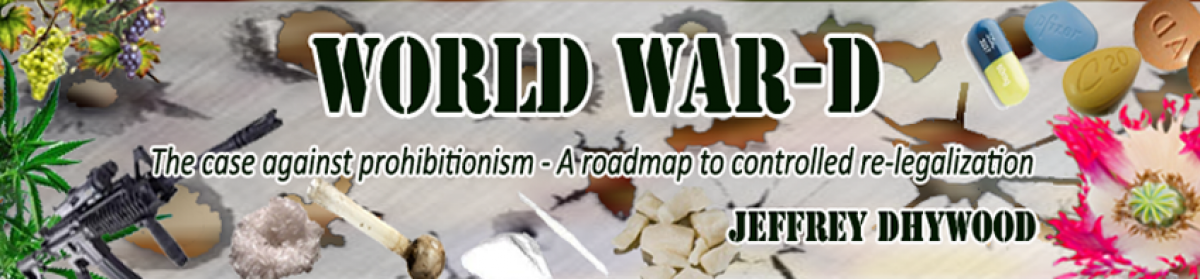
The war on drugs is also a cultural war, touting alcohol, the dominant psychoactive  substance of Western civilization, against the dominant psychoactive substances of Andean or Eastern civilization: coca leaf, cannabis and opium; meanwhile, the western-dominated pharmaceutical industry is flooding the planet with a new generation of psychoactive substances in its (so far very successful) attempt at medicalization of normalcy. This, by the way, is one of the dominant theme of my just released ” World War-D: the case against prohibitionism. A roadmap to controlled re-legalization.”

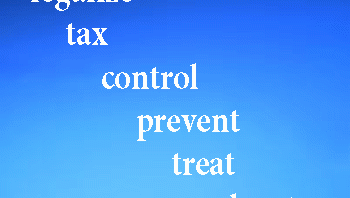
The only viable long-term solution to the drug issue: global re-legalization under a multi-tiers “legalize, tax, control, prevent, treat and educate” regime with practical and efficient mechanisms to manage and minimize societal costs.

Far from giving up and far from an endorsement, controlled legalization would be finally growing up; being realistic instead of being in denial; being in control instead of leaving control to the underworld. It would abolish the current regime of socialization of costs and privatization of profits to criminal enterprises, depriving them of their main source of income and making our world a safer place.